
When Garena Free Fire decided to make a splash in esports, it did not simply dip a toe in the water. The popular battle royale title put together a year-long calendar of high-stakes tournaments backed by a $2 million prize pool, including a return to Brazil for the World Series—where it had previously smashed the two million concurrent viewer mark. For a mobile game that many rivals initially underestimated, this was a full-blown power move.
Four Chances to Make a Statement
The first big moment arrived on 19th April in Jakarta, Indonesia, with the Free Fire Champions Cup. Qualifiers had already kicked off across multiple regions, giving grassroots squads a taste of competitive action. After a string of local and regional battles, 12 teams from nine different regions punched their tickets to the main event. That structure meant the field was not just the usual suspects—there was room for dark horses and breakout stars.
Here is how the year shaped up:
| Window | Event | Key Detail |
|---|---|---|
| April | Free Fire Champions Cup | Jakarta, 12 teams from 9 regions |
| June | Unannounced tournament | First-of-its-kind format |
| July | Unannounced tournament | First-of-its-kind format |
| November | Free Fire World Series | Returns to Brazil |
Brazil and the Big Stage
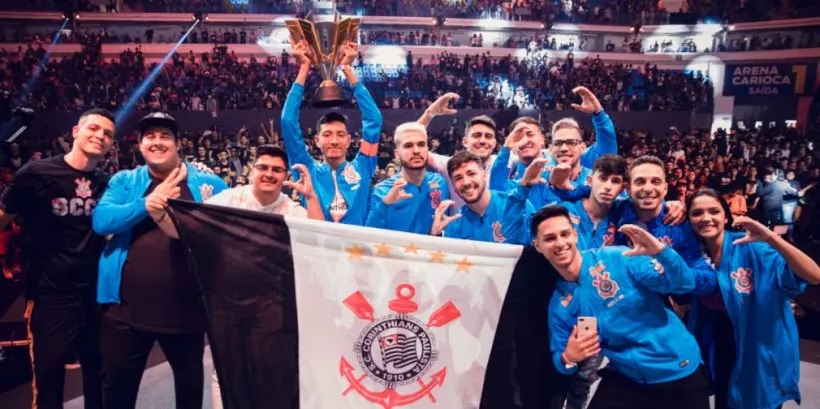
In November, the Free Fire World Series made its way back to Brazil. The South American crowd had already witnessed the game hit a staggering two million concurrent viewers during a prior World Series, a record for a mobile esports tournament. That was not a fluke. It signaled that mobile battle royale could generate the same electricity as PC and console showcases. Brazil did not just host a tournament; it hosted a statement.
Mystery Events in the Middle
One of the smarter moves was avoiding a long lull between spring and autumn. Garena added two tournaments in June and July, both described as first-of-their-kind. The publisher chose to keep specifics under wraps for a while, which sent fans into a frenzy of predictions. Would it be a team-based siege mode? A creator showdown? A cross-regional clash? Nobody knew, and that ambiguity only amped up the hype.
More Than Just Prize Money
The headline figure was $2 million in total prize money, divided among winners, runners-up, and top performers across all four events. By 2026 standards, that might read as modest—some modern esports seasons throw around far bigger numbers—but at the time it was a serious signal. Crucially, extra events created extra lanes for talent. Up-and-coming players had more stages to prove themselves, and sharper eyes from established organizations were watching. In esports, exposure can be worth more than a paycheck.
A Blueprint That Still Echoes
Looking back from 2026, the four-event structure feels like an early blueprint for mobile esports growth. The scene has changed dramatically since then: viewership records have tumbled, sponsorships have multiplied, and top-tier organizations now run dedicated mobile rosters. Yet the logic remains the same—frequent tournaments, clear paths to the top, and a global footprint give players and fans a reason to stay invested.
Why it worked:
-
🎮 Free-to-play accessibility lowered the barrier to entry for curious newcomers.
-
🌍 Regional qualifiers turned local fanbases into global storylines.
-
🏆 A $2 million prize pool proved Garena was serious about longevity.
-
📱 The two million viewer milestone showed mobile esports could pack a real punch.
The Road Ahead
Free Fire continues to be available on the App Store and Google Play as a free-to-play title with in-app purchases. That means the next champion could still be grinding through ranked matches at this very moment. If the 2020 season taught the industry anything, it is that talent can emerge from anywhere—and a well-structured calendar gives that talent a real shot. Fancy yourself a future esports star? The drop zone is always open.